
by Nina Wilkinson, CFA
The transparency dividend
In February 2024, the Workplace Gender Equality Agency (WGEA) published private sector employer-level gender pay gap data[1] for the first time, a watershed moment for transparency in corporate Australia. Three years of reported data later, this transparency has helped drive a reduction in the national wage gap from 13.3 to 11.5%, according to Australian Bureau of Statistics data. Encouragingly, more and more employers are analysing and taking action to address pay disparity. Yet, as outlined in the chart below, when overtime, bonus and part-time workers are taken into account as well, Australian women still receive just 79 cents to every dollar of equivalent male earnings. The persistence of this gap is not only a social equity issue, it also represents a significant drag on national productivity and economic growth.
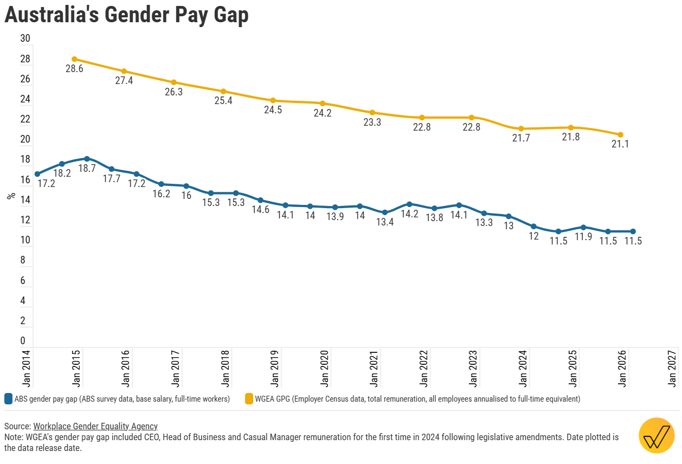
Source: https://www.wgea.gov.au/data-statistics/ABS-gender-pay-gap-data
The economic imperative
The economic case for closing the gender pay gap is well established and substantial. KPMG has estimated the annual cost of the gender pay gap to the Australian economy at $65.8 billion.[2]Research published in Economic Analysis and Policy found that narrowing the wage gap by one point delivers approximately 0.5% of GDP growth, while a 10% reduction could boost per capita output by up to 3%.[3]
The OECD reinforced these findings, noting that increased women’s labour market participation was a meaningful contributor to per capita GDP growth across OECD countries – including Australia – between 2000 and 2022[4]. Analysis[5] has shown that female workforce participation is one of the key drivers of our gender pay gap. So too are gender segregation in job type and industry, as well as gender-related influences such as discrimination and recruitment bias.
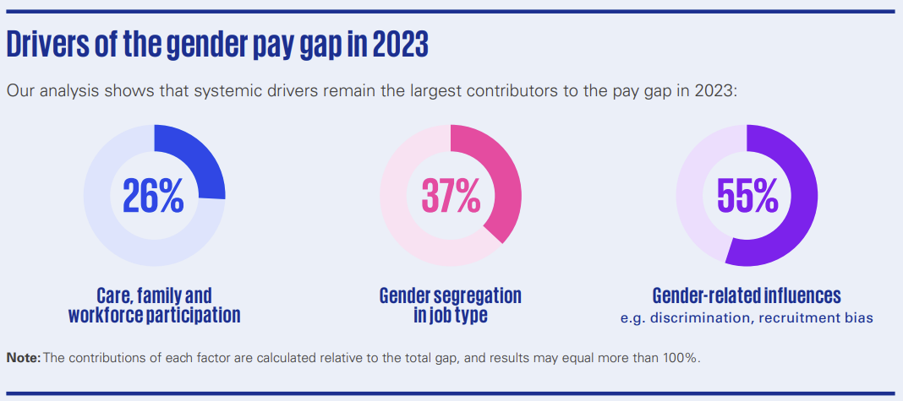
Source: KPMG She’s Price(d)less 2026 report: The economics of the gender pay gap
Three years of transparency: what has changed for listed companies?
The impact of WGEA’s transparency regime has been measurable. When employer pay gaps were first published in February 2024, the proportion of private employers conducting a pay gap analysis stood at 55%; within twelve months it jumped to 68%, with 90% of those analyses conducted in the year immediately following publication. Additionally, 75% of employers that analysed their gap were taking concrete action on the results, compared with 60% before the data was published.[6]
For ASX-listed companies, the scrutiny is particularly acute. From this year’s data release, we learned that 9 out of the top 10 ASX-listed companies had a pay gap favouring men larger than WGEA’s target range of +/-5%,[7] and only 12 out of the top 100 ASX-listed companies fell within the target range.[8]
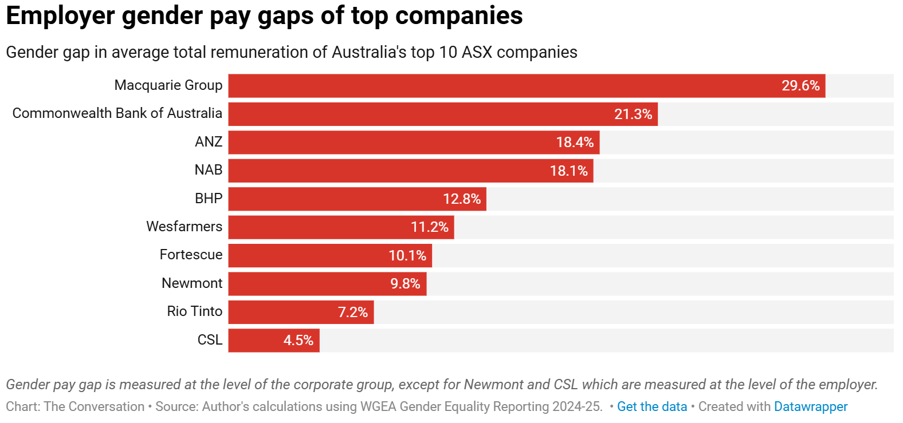
Source: The Conversation
Australian legislation raising the global bar: WGEA Targets
In contrast to the diversity backlash overseas, a landmark regulatory development is now underway in Australia. From May 2026, large employers (500+ employees) are required, in a world-first initiative, to select and commit to three Gender Equality Targets from a menu of 19 options — nine numeric and ten action-based — and must demonstrate improvement from their baseline within three years. While there are no direct financial penalties, non-compliant employers risk being publicly named in Parliament, potentially losing their WGEA Certificate of Compliance, and being rendered ineligible to tender for Commonwealth government contracts and grants. For listed companies, the reputational and commercial stakes are substantial. Melior’s own analysis reinforces the point that target-setting leads to positive outcomes: companies that set 40:40 gender representation targets for their Executive Leadership Team are 2.7 times more likely to achieve gender balance than those with no gender targets.[9]
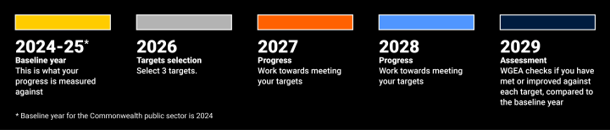
WGEA Targets Timeline. Source: https://www.wgea.gov.au/targets/FAQs
Values to value: the connection between gender equality and financial returns
The evidence base is now extensive: McKinsey’s Diversity Matters research has consistently found that companies in the top quartile for gender diversity on executive teams are materially more likely to outperform peers on profitability, with the most recent update finding a 39% greater likelihood of financial outperformance for top-quartile companies.[10]Credit Suisse’s CS Gender 3000 series similarly documented superior share-price performance and return on equity for companies with higher female representation in senior management.[11]
Melior believes that the gender pay gap is not an abstract social metric for investors, it is a proxy for how effectively a company manages its most important asset: its people. Companies that fail to address systemic pay disparities face growing regulatory risk under the new WGEA targets regime, talent retention challenges, and reputational exposure in an era of mandatory transparency. Conversely, companies that lead on gender equality tend to attract stronger talent pipelines and foster more productive and innovative workforces. That is why Melior has applied a gender lens since our fund’s inception in 2019.
Melior’s Gender Equality Approach
The Melior Australian Impact Fund is one of the first Australian or New Zealand listed equities funds to apply a gender lens to its investment process[12], recognising that gender equality is both a material economic opportunity and critical driver of long-term company performance. Our approach rests on three pillars:
- Gender Lens Investing[13] Framework incorporated into our Impact Assessment to identify gender leaders (refer Wesfarmers example below);
- Active Corporate Stewardship through engaging listed companies on their gender equality credentials; and
- Public Advocacy through levers such as publishing our ASX300 gender data and speaking in the media and at conferences on gender equality
Melior also reports on our gender equality progress in our annual impact report and our quarterly performance report. Over FY26 to date, Melior has had 40 engagements with ASX listed companies regarding gender equality, including gender pay gaps, WGEA targets, and female representation at the board and executive leadership team (ELT) level. The fund also tracks and reports several gender metrics on a quarterly basis. The table below shows Melior’s performance vs the ASX300 on several gender-focussed metrics, as at 31 March 2026.
For more information on our gender approach, see our gender equality paper.
| Social Inclusion | Portfolio | ASX 300 |
| ELT gender target of 40:40:20 | 64% | 40% |
| Female Leader (CEO and/or Chair) | 17% | 24% |
| Females on ELTs | 37% | 30% |
| Females on boards | 40% | 36% |
| Gender pay gap target of +/- 5% | 22% | 14% |
Gender Leader Case Study: Wesfarmers
Melior has identified Wesfarmers as a leader under our Gender Lens Investing framework since 2019, and we have conducted numerous engagements with board and management over this time, including dedicated discussions of gender pay gaps and workforce diversity objectives.
Wesfarmers is one of Australia’s largest listed employers with more than 118,000 team members across retail, industrial and chemicals businesses, Wesfarmers’ 2024–25 WGEA results show meaningful progress: the Group’s median total remuneration gender pay gap has fallen to 3.1%, comfortably within WGEA’s target range of plus or minus 5%, down from 4.8% the previous year. The average total remuneration gap also narrowed, from 11.8% to 11.2%.[14]
Critically, the results are strongest where the workforce is largest: Bunnings (average GPG of 5.2%), Kmart (3.5%) and Target (1.9%), businesses employing over 100,000 people collectively, all sit within or near WGEA’s target range. While many of Wesfarmers’ other businesses still have room to improve, these results show what is possible to achieve when gender balance is prioritised in governance, culture and strategy and when human capital is viewed as a vital asset through which to achieve sustainable long-term returns for shareholders.
The Wesfarmers Board has set an explicit objective for all gender pay gaps to be at or below 5% and has received an annual gender pay equity review since 2010, well before WGEA’s transparency reforms. The company targets 40% female, 40% male, and 20% of any gender at all levels of the organisation, including leadership. As of June 2026, female representation on the Executive Leadership Team (ELT) reporting to the CEO stood at 46% and 40% of the Wesfarmers board directors (including the CEO) were women.
Whilst it is difficult to disaggregate the role of diversity in driving performance on a company-by-company basis, since Melior has invested in Wesfarmers over an almost a 7-year period, its shares have returned 19.5% p.a. compared to 8.0% p.a. for the ASX 300 Index (including dividends).[15] Wesfarmers Managing Director Rob Scott has stated that “having the most capable, engaged and effective team is essential if we are to achieve our primary objective, which is to deliver a satisfactory return to shareholders over the long term.” Wesfarmers Board and Leadership Team also “remain fully committed to maintaining team member diversity, gender equality and pay equity.”[16]
Conclusion
Melior has been analysing companies with a gender lens for 7 years and has observed that this can contribute to stronger company performance. The increased transparency of gender data is an opportunity for fund managers to incorporate a gender lens into their investment process, alongside other financial and non-financial considerations.
Disclaimer: Please note that these are the views of the writer and not necessarily the views of Melior Investment Management or The Trust Company (RE Services) Limited (ABN 45 003 278 831, AFSL No. 235150) as Responsible Entity and issuer of units in the Melior Australian Impact Fund. You should consider the product disclosure statement (PDS), prior to making any investment decisions. The PDS and target market determination (TMD) can be obtained by visiting our website https://meliorim.com.au/. Past performance is not indicative of future performance.
Some small changes were made to this article, based on updated information. This article does not take into account your investment objectives, particular needs or financial situation and has been prepared for general information purposes only and must not be construed as investment advice or as an investment recommendation.
[1] The gender pay gap is the difference between the average or median earnings of men and women across an employer’s workforce, expressed as a percentage of men’s earnings.
[2] She’s Price(d)less, The economics of the gender pay gap, KPMG , January 2026. https://kpmg.com/au/en/insights/workforce/shes-priced-less-gender-pay-gap-economics.html
[3] Kennedy, Tom & Rae, Maria & Sheridan, Alison & Valadkhani, Abbas, 2017. “Reducing gender wage inequality increases economic prosperity for all: Insights from Australia,” Economic Analysis and Policy, Elsevier, vol. 55(C), pages 14-24.
[4] Fluchtmann, J., W. Adema and M. Keese (eds.) (2024), “Gender equality and economic growth: Past progress and future potential”, OECD Social, Employment and Migration Working Papers, No. 304, OECD Publishing, Paris, https://doi.org/10.1787/fb0a0a93-en.
[5] She’s Price(d)less, The economics of the gender pay gap, KPMG , January 2026. https://kpmg.com/au/en/insights/workforce/shes-priced-less-gender-pay-gap-economics.html
[6] WGEA, Australia’s Gender Equality Scorecard, Nov 2024. https://www.wgea.gov.au/sites/default/files/documents/Australia%27s%20Gender%20Equality%20Scorecard%202023-24_V09%20%281%29.pdf
[7] https://theconversation.com/australias-gender-pay-gap-is-narrowing-and-the-public-spotlight-seems-to-be-helping-276957
[8] https://www.afr.com/work-and-careers/workplace/why-is-it-so-hard-for-some-companies-to-do-better-on-gender-pay-20260226-p5o5py
[9] CEW Senior Executive Census 2025 https://cew.org.au/hubfs/25_01%20CEW%20CENSUS%20ACC%20FINAL.pdf?hsLang=en-au
[10] McKinsey & Company, Diversity Matters Even More: The case for holistic impact, 2023. https://www.mckinsey.com/featured-insights/diversity-and-inclusion/diversity-matters-even-more-the-case-for-holistic-impact
[11] https://www.wgea.gov.au/sites/default/files/documents/csri-gender-3000.pdf
[12] A Roadmap for Australian Investors: How to invest to achieve gender equity, racial equity, diversity and inclusion, 2022 A-Roadmap-for-Australian-Investors-28-March-2022.pdf. Melior reference at page 67.
[13] Gender Lens Investing (GLI) is defined by the Criterion Institute as “the incorporation of gender analysis into financial analysis in order to make better investment decisions.”
[14] Wesfarmers 2024-25 WGEA Report https://www.wesfarmers.com.au/docs/default-source/corporate-governance/2024-25-wesfarmers-gender-pay-statement_wgea.pdf?sfvrsn=3c6ed9bb_3
[15] LSEG Workspace, annualized total return, calculated over 1 July 2019 to 31 May 2026.
[16] Wesfarmers 2024-25 Gender Pay Gap Statement, page 4, https://www.wesfarmers.com.au/docs/default-source/corporate-governance/2024-25-wesfarmers-gender-pay-statement_wgea.pdf?sfvrsn=3c6ed9bb_3